
Quick answer
The short version
01
What does MOQ actually mean for a towel order?
MOQ stands for minimum order quantity. It is the smallest number of pieces a manufacturer can run for one design while keeping the order technically workable and commercially sensible for both sides.
It is normally quoted per design rather than per purchase order. Three colourways of the same towel in one shipment are usually three separate production runs, so each colourway carries its own minimum. That distinction matters when you plan a range rather than a single product.
A minimum is not a negotiating position invented to push volume. It reflects real setup work: reserving material, preparing a cutting plan, setting up a decoration route, running a first-piece approval and configuring the packing line. Spreading that fixed work over too few units is what makes very small runs uneconomic.
02
What pushes a towel minimum up or down?
- Material and construction. A standard terry towel in a stocked composition is easier to run in smaller numbers than a special construction that has to be sourced for the order.
- Colour. Dyed-to-match colours and custom Pantone shades carry their own preparation, so a colour that already exists in the supply chain is usually the cheaper route.
- Decoration. Each method has its own setup. Embroidery depends on stitch count and logo complexity; printing depends on colour count and coverage.
- Size and weight. Unusual dimensions and heavy weights consume more machine time and material per piece.
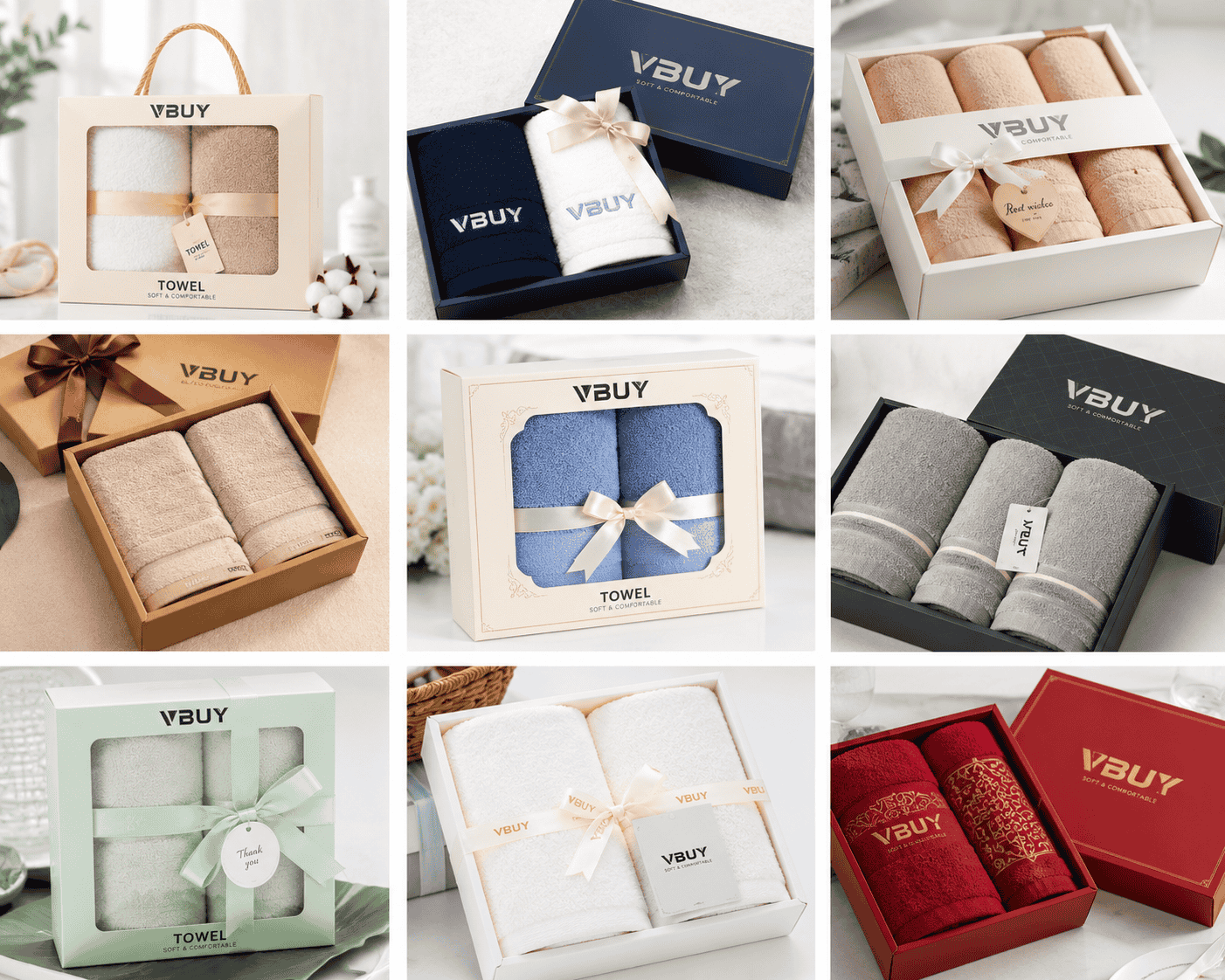
- Packing. A polybagged bulk carton is a different proposition from a retail gift box with an insert, a card and a printed sleeve.
03
What are typical minimums for the main towel routes?
| Product route | Typical starting minimum | What moves the number |
|---|---|---|
| Plain or dyed towel, no decoration | Around 500 pieces per design | Material availability, finished size and target weight |
| Printed towel | Around 500 pieces per design | Number of colours and how much of the surface is covered |
| Embroidered towel | Around 500 pieces per design | Stitch count, logo size and number of positions |
| Complex construction or special finishing | Confirmed per project, often higher | Technical feasibility and material minimums |
| Gift box or retail set | Confirmed per project, often higher | Component count, packaging minimums and assembly |
These are planning starting points rather than standing offers. Minimums are confirmed per project against the actual specification, and a mixed-colour or mixed-size program is quoted on its own basis.
04
How can a buyer plan around a minimum quantity?
The practical question is rarely how to go below the minimum, but how to get more value from the quantity you are already ordering. Several adjustments move an order into a better position without changing the product the customer will eventually use.
- Concentrate colourways. Fewer colours with more pieces each is usually easier to run than the same total split across many shades.
- Use one decoration method across the range instead of mixing embroidery and printing on similar products.
- Start from a material that is already available rather than a bespoke composition.
- Keep the first order in bulk packing and develop the retail presentation once the product itself is proven.
- Run a pilot quantity for the market test, then place the larger program against the approved specification.
05
How does the minimum quantity relate to sampling and lead time?
Quantity, specification and timing move together. A larger run takes longer to produce and check, and a more complex specification takes longer to develop before production even begins. Planning them separately is what produces the familiar problem of a delivery date fixed before the specification was settled.
The workable sequence is to confirm the specification first, develop the sample, then place the bulk quantity against the approved reference. Changing the quantity after sampling is usually straightforward. Changing the specification is not, because it invalidates the reference the sample established and the approval has to be repeated.
Where a launch date is fixed, it is usually better to reduce the opening quantity and hold the specification than to compress the development stage. A smaller first shipment that arrives on time and matches the approved product supports the launch better than a larger one that arrives late or has to be corrected.
06
What should you confirm before you brief a supplier?
A minimum quantity is an output of a specification, not an input. The fastest way to get a real number is to send one complete brief so the manufacturer can price the actual route rather than guess at a range.
Send the quantity you expect to sell rather than a placeholder figure chosen for negotiation. A supplier can then confirm whether that volume is workable and, where it is not, point to the part of the specification that could be adjusted to bring the minimum down without changing the product your customer eventually sees.
If some details are genuinely undecided, say so explicitly. Marking an unknown as unknown lets the supplier propose a sensible route instead of pricing against an assumption that later turns out to be wrong.
07
Does a larger quantity always mean a lower unit price?
Larger runs generally spread fixed setup work across more pieces, which improves the unit price. But the curve flattens. Beyond a certain point the saving per piece becomes small, while the working capital tied up in stock and the risk of holding unsold inventory keep rising.
For a first order in a new market, a moderate quantity that proves the product is often worth more than the lowest possible unit price. The specification approved on that order becomes the reference for every repeat.
08
Buyer questions
01Can I order less than 500 pieces?+
A smaller quantity is sometimes possible, but it has to be discussed against the specific construction, decoration and packing rather than assumed. Where a lower run is feasible, the cost per piece usually rises because the setup work is spread over fewer units.
02Do printed and embroidered towels have the same MOQ?+
Both routes commonly start from a similar baseline, but the drivers differ. Printing minimums are influenced by colour count and coverage, while embroidery minimums are influenced by stitch count and logo complexity. Confirm the figure for the exact decoration you have chosen.
03Can I mix colours within the MOQ?+
Mixed colourways can be discussed, but the basis depends on how the colours are produced and whether each colour counts as a separate design. Confirm this point before you plan a range, because it changes how the total quantity is counted.
09
Buyer brief checklist
Include these points when asking VBUY or another supplier to evaluate the project:
- Towel type and intended use
- Target quantity and whether it can flex
- Number of designs and colourways
- Decoration method and artwork
- Packing format
- Destination market and required date