Quick answer
The short version
01
What are the different kinds of compliance evidence?
| Evidence type | What it actually tells you | What it does not tell you |
|---|---|---|
| Product certification | That the named product or range was tested and meets a defined standard | That every product from the facility is covered |
| Scope certification | That the facility is qualified for the listed processes and materials | That any individual shipment qualifies automatically |
| Social compliance audit | That an assessment was carried out against an audit methodology | That the facility passed, or that the product is certified |
| Verified assessment | That submitted facility data was independently verified | A pass or fail grade, or product-level compliance |
02
What does a product certification such as OEKO-TEX cover?
OEKO-TEX STANDARD 100 is a product-level testing scheme. It certifies that the articles named on the certificate have been tested against the standard's limit values. The product class matters: Class I is the strictest category, covering articles intended for babies and young children, and it represents a stronger claim than a general textile certification.
The scope statement on the certificate is the part to read closely. It names which products and which materials are covered. A certificate covering microfibre towels does not automatically extend to a bath towel, a bathrobe, or a beach towel made from a different composition.
03
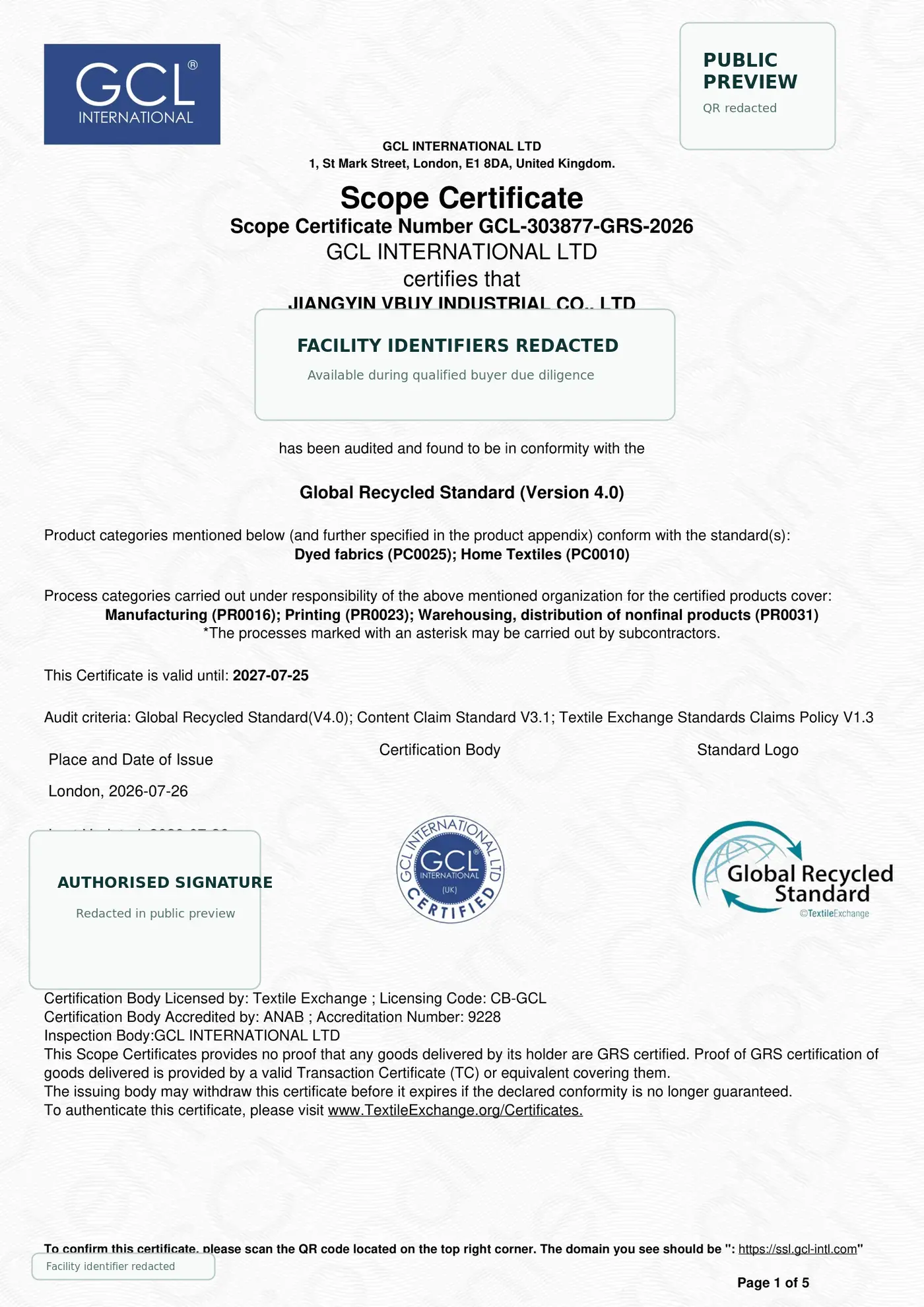
What does a GRS scope certificate actually prove?
The Global Recycled Standard covers recycled content. A scope certificate confirms that a facility is qualified for the listed processes and materials within the standard's chain-of-custody requirements.
The important distinction for buyers is between the scope certificate and the transaction certificate. The scope certificate qualifies the facility. It does not certify any individual shipment. For a recycled-content claim on a specific order, the applicable transaction documentation is what supports the claim, and it should be requested against that order rather than assumed from the scope certificate.
05
What should you ask before placing an order?
Asking these questions early is normal due diligence, not a sign of distrust. Suppliers who hold current records are usually straightforward about the scope, because the scope is what makes the record meaningful.
- Which document are you being shown, and what category does it fall into?
- Whose name is on it? The certificate holder may be the manufacturing entity rather than the brand you are buying from.
- What exactly is the product scope? Does it name the material and product type you are ordering?
- Is it current, and what period does it cover?
- For a recycled-content claim, what order-level documentation will accompany the shipment?
- For social compliance, can the full report be shared with your vendor approval team?
06
How do you keep compliance records current?
Certification and audit records have a life cycle. Product certificates are renewed on a testing cycle, scope certificates are amended when a facility adds or removes a process, and social audits are repeated at intervals set by the buyer program or the retailer's own vendor requirements.
The practical consequence is that a document reviewed two years ago should not be treated as current today. When a program runs across several seasons, re-confirm the records at the point of each order rather than relying on the file assembled at the start of the relationship.
It is also worth knowing who holds each record. The brand a buyer deals with and the entity named on a certificate are not always the same legal body, and a document issued to the manufacturer may need to be presented differently in a vendor approval file than one issued to the trading company.
07
How should compliance records be used in your buying decision?
Treat compliance evidence as one input among several. It confirms that defined testing or monitoring has taken place; it does not replace the sample, the quality checks or the commercial terms.
The records are also worth reading for what they do not claim. A statement that a facility has been assessed is not a statement about the product you will receive, and treating the two as equivalent is the most common way compliance evidence is misused in an approval file.
Keep the documents filed against the order they relate to, and re-check validity when you place a repeat order. Certificates expire, scopes are amended, and an assessment from several years ago may no longer reflect how a facility operates today.
08
Buyer questions
01Does a GRS scope certificate cover my shipment?+
No. A scope certificate qualifies the facility for the listed processes and materials. For a recycled-content claim on a specific order, the applicable Transaction Certificate documentation is what supports that claim, and it should be requested against the order itself.
02Can I get a test report for my specific product?+
Product-level testing is arranged per project. Tell the supplier which standard and which product the report needs to cover, and confirm whether the requirement is for the specific order or for the range the product belongs to.
03Are BSCI and SMETA the same as a product certification?+
No. Both are social compliance audit frameworks, not product certifications or pass or fail grades. They record that an assessment took place against a defined methodology and are used for facility-level visibility.
09
Buyer brief checklist
Include these points when asking VBUY or another supplier to evaluate the project:
- Which compliance documents your program requires
- The exact product and material the document must cover
- Whether the claim is order-level or range-level
- Who the certificate holder needs to be
- Validity period and re-check date
- Whether a full report is needed for vendor approval
04
What do BSCI and SMETA audits tell you?
amfori BSCI and SMETA are social compliance audit frameworks. They record that an assessment was carried out against a defined methodology covering areas such as labour standards, health and safety, environment and business ethics.
Neither is a product certification, and neither is a pass or fail grade in the way a product test is. They are monitoring tools that give a buyer visibility into how a facility operates. A full report typically contains controlled facility and employee information, which is why reports are usually shared directly with qualified buyers rather than published openly.
A verified Higg Facility Social and Labor Module assessment sits in a related but distinct category. It confirms that submitted facility data was independently verified through the SLCP framework. It is a verified assessment record, not a certification or a compliance grade.